

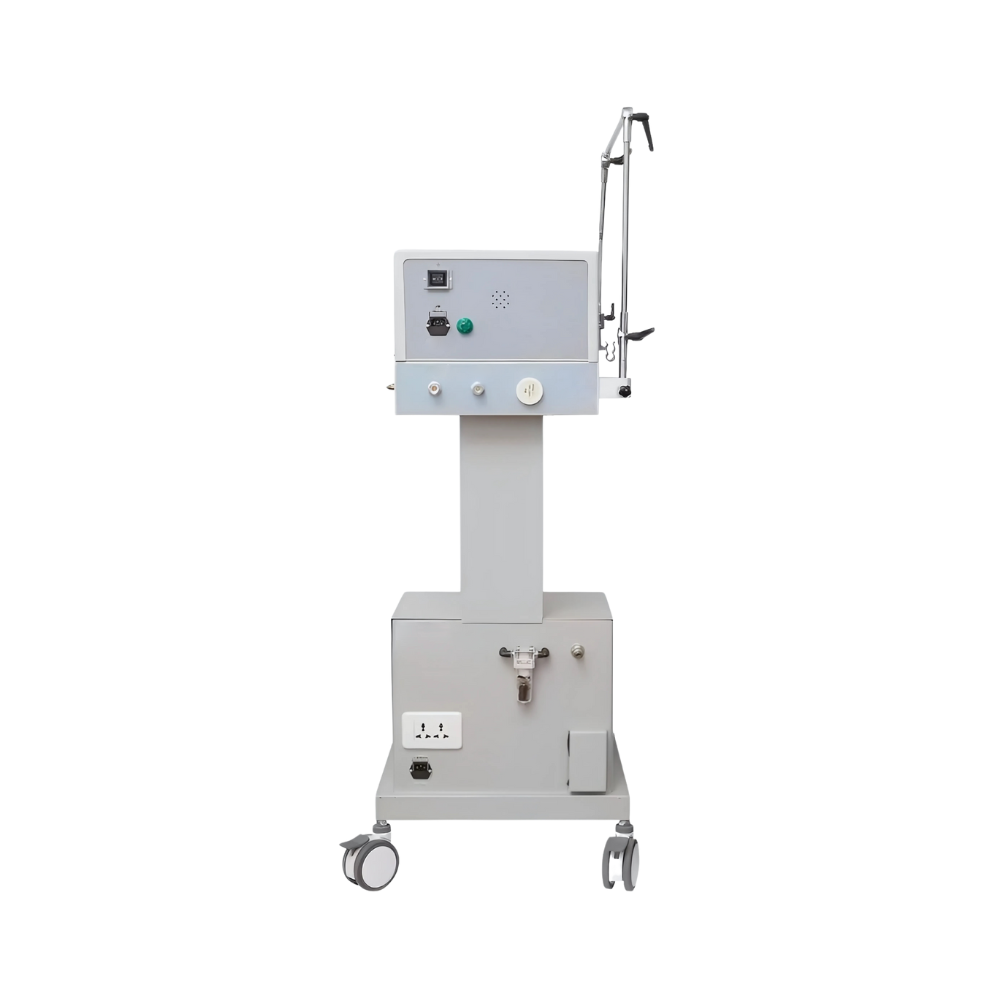
Ventilator System MVS-704 features 10.4-inch TFT display providing intuitive control and monitoring. This system offers multiple ventilation modes, with an SIMV rate adjustable between 1 and 20 bpm. It is equipped with a built-in air compressor delivering continuous gas flow and instantaneous flow, ensuring effective ventilation support. It is a versatile respiratory support device designed for both adult and pediatric patients. It remains lightweight, including the PA air compressor, which makes it suitable for intensive clinical environments.
| Tidal Volume | Adjustable: 50 to 1500 ml Display range: 0 to 2000 ml |
| Respiratory Rate | 1 to 99 bpm |
| Inspiratory Pressure Limit | 10 to 60 cmH₂O |
| Ventilation Modes | Manual, Spontaneous, Standby, Assist/Control (A/C), IPPV, SIPPV, IMV, SIMV |
| Minute Volume | ≥ 18 L/min BTPS |
| Trigger Sensitivity | Pressure: -10 to 10 cmH₂O |
| SIMV Rate | 1 to 20 bpm |
| Inspiration/Expiration Ratio (I:E) | 4:1 to 1:4 |
| Inspiratory Time | 0.1 to 2.0 s |
| PEEP | 0 to 10 cmH₂O |
| O₂ and Air Inlet Pressure Range | 280 to 600 kPa |
| O₂ Concentration | 21 to 100% |
| SIGH | 1 to 8 per 100 breaths |
| Humidifier | 9-Level Adjustable Nebulization |
| Compressor Power | 220 V, 50 Hz, 700 VA |
| Compressor Gas Pressure | 0.3 to 0.5 MPa |
| Output Gas Flow | Continuous ≥ 20 L/min Instantaneous ≥ 60 L/min |
| Patient Type | Adult and Pediatric Patients |
| Display | 10.4-inch TFT display |
| Power Supply | 220 to 240 V, 50 to 60 Hz |
| Backup Power | At least 30 minutes, typically 2 to 4 hours |
| Dimensions (H × W × D) | 124 cm × 67 cm × 60 cm |
| Weight | 77 kg (with PA air compressor attached) |
Our Ventilator System MVS-704 is designed for use in a wide range of clinical settings, offering reliable respiratory support for both adult and pediatric patients. It is ideal for intensive care units (ICUs), emergency departments, operating rooms, post-operative recovery areas, and transport scenarios within medical facilities.
Our Ventilator System MVS-704 is designed for use in a wide range of clinical settings, offering reliable respiratory support for both adult and pediatric patients. It is ideal for intensive care units (ICUs), emergency departments, operating rooms, post-operative recovery areas, and transport scenarios within medical facilities.
Consult Our Experts
Frequently Asked questions
What makes the Ventilator System suitable for both adult and pediatric patients?
The Ventilator System is engineered with adjustable tidal volumes (50 to 1500 ml), multiple ventilation modes, and finely tunable parameters like inspiratory pressure, PEEP, and trigger sensitivity, making it adaptable to a wide range of patient sizes and needs—from infants to adults.
How does the SIMV functionality in the Ventilator System benefit patient ventilation?
The Ventilator System’s SIMV (Synchronized Intermittent Mandatory Ventilation) rate is adjustable between 1 and 20 bpm, allowing synchronization with a patient's spontaneous breaths while providing essential mechanical support, ideal for weaning patients off full ventilation.
What power backup options does the Ventilator System offer in the event of power failure?
The Ventilator System includes an internal battery system offering a minimum of 30 minutes of backup power, typically providing up to 2 to 4 hours of operation, ensuring continuous respiratory support during unexpected outages or transport within the facility.
How does the Ventilator System maintain patient safety with pressure controls?
With a pressure limit range of 10 to 60 cmH?O and adjustable trigger sensitivity from -10 to 10 cmH?O, the Ventilator System allows clinicians to set safe and responsive pressure parameters tailored to each patient's condition.
In which clinical settings can the Ventilator System be deployed?
The Ventilator System is designed for use in ICUs, emergency departments, operating theaters, post-operative care units, and for intra-hospital transport. Its compact design and powerful built-in compressor make it highly adaptable across critical care environments.
What display and monitoring features does the Ventilator System offer for clinicians?
It features a 10.4-inch TFT display that provides real-time monitoring and intuitive control of ventilation parameters, enhancing usability and ensuring precise patient management.
What makes the Ventilator System ideal for post-operative care and emergency use?
Its fast setup, multiple ventilation modes, compact form factor, and built-in air compressor ensure rapid deployment and continuous respiratory support in high-pressure environments like emergency departments and recovery rooms.
Are Ventilator Systems suitable for pediatric patients?
Yes, they are designed for both pediatric and adult patient care.
What makes the Ventilator System a reliable choice for hospitals and ICUs?
The Ventilator System offers advanced respiratory support with multiple ventilation modes including IPPV, SIMV, CPAP, PRVC, APRV, and more. Its integrated real-time monitoring, servo-controlled humidifiers, and adjustable dual-heating pipelines ensure optimal clinical performance and patient comfort. These features make it a reliable and trusted choice for intensive care and emergency units globally.
How do Ventilator Systems enhance patient comfort during long-term ventilation?
Ventilator Systems are equipped with advanced humidifiers featuring adjustable humidity levels and dual heating pipelines. This ensures consistent warmth and moisture in the airflow, minimizing irritation and improving patient comfort, especially for those requiring extended ventilatory support.
Can Ventilator Systems be used in emergency transport or field conditions?
Yes, offers portable ventilator system options within its product range. These units are compact, lightweight, and durable, making them suitable for emergency transport or on-site critical care.
How does the touchscreen interface on the Ventilator System improve clinical efficiency?
The high-resolution TFT or LCD touchscreen provides intuitive navigation and real-time parameter tracking. This allows clinicians to make rapid, accurate adjustments to ventilation settings, improving patient outcomes and workflow efficiency.


