

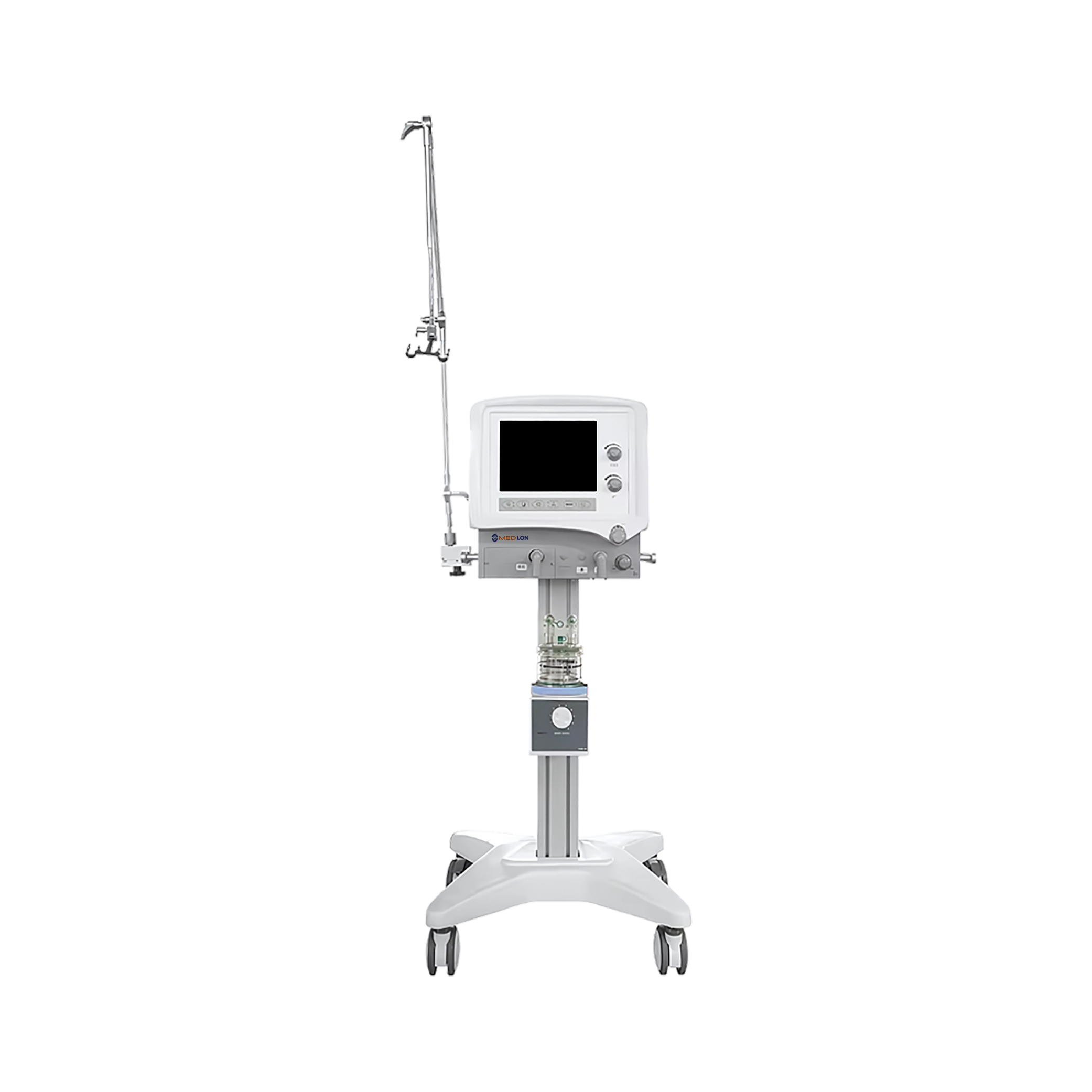
Ventilator System MVS-701 features pressure-trigger sensitivity ranging from -20 to 0 cmH₂O and configurable sigh functions and apnea ventilation settings. It is equipped with a 10.4-inch TFT screen for intuitive monitoring. This system supports multiple ventilation modes and manual ventilation to accommodate patient-specific needs. Its safety features include multiple alarms for oxygen concentration, airway pressure, minute volume, suffocation risk, and continuous pressure. With compact dimension and weight, it can be mounted on a trolley for mobility and ease of use in critical care settings.
| Ventilation Modes | IPPV, A/C, SIMV, SPONT/CPAP, SIGH, MANU |
| Ventilator Tidal Volume (Vt) | 20 mL to 1500 mL |
| Ventilator Frequency (Freq) | 1 min to 100 min |
| Ventilator I:E Ratio | 4:1 to 1:8 |
| Ventilator Oxygen Concentration | 45% to 100% |
| Ventilator PEEP | 0 cmH₂O to 20 cmH₂O |
| Ventilator Pressure Trigger Sensitivity (Ptr) | -20 cmH₂O to 0 cmH₂O (Based on PEEP) |
| Ventilator SIGH | 0 (off) / 1 / 100 to 5 / 100 |
| Apnea Ventilation | OFF, 5 s to 60 s |
| Monitoring Frequency (Freq) | 0/min to 100/min |
| Monitoring Tidal Volume (Vt) | 0 mL to 2000 mL |
| Monitoring MV (Minute Volume) | 0 L/min to 99 L/min |
| Monitoring Airway Pressure | 0 cmH₂O to 100 cmH₂O |
| Monitoring Oxygen Concentration | 15% to 100% |
| Low Battery Voltage Alarm | < 11.3 ± 0.3 V |
| High O₂ Concentration Alarm | 19% to 100% |
| Low O₂ Concentration Alarm | 18% to 99% |
| High Airway Pressure Alarm | 20 cmH₂O to 100 cmH₂O |
| Low Airway Pressure Alarm | 0 cmH₂O to 20 cmH₂O |
| High Minute Volume Alarm | 1 L/min to 99 L/min |
| Low Minute Volume Alarm | 0 L/min to 20 L/min |
| Continuous Pressure Alarm | PEEP + 1.5 kPa over 16 s |
| Suffocation Warning | 5 s to 60 s no spontaneous ventilation |
| Display | 10.4 |
| Pressure | 280 kPa to 600 kPa |
| Voltage | 220 V ± 22 V |
| Power Frequency | 50 Hz ± 1 Hz |
| Input Power | 40 VA |
| Oscillogram Display | P-T (Pressure–Time) F-T (Flow–Time) |
| Unit Dimensions (L × W × H) | 560 × 560 × 615 mm |
| Trolley Dimensions (L × W × H) | 650 × 680 × 620 mm |
| Unit Net Weight | 16 kg |
| Unit Gross Weight | 30 kg |
| Trolley Net Weight | 11 kg |
| Trolley Gross Weight | 37 kg |
Our Ventilator System MVS-701 is designed to provide advanced respiratory support across a wide range of clinical settings. It is ideal for use in intensive care units (ICUs), emergency departments, operating rooms, and during patient transport within healthcare facilities.
Our Ventilator System MVS-701 is designed to provide advanced respiratory support across a wide range of clinical settings. It is ideal for use in intensive care units (ICUs), emergency departments, operating rooms, and during patient transport within healthcare facilities.
Consult Our Experts
Frequently Asked questions
What clinical settings is the Ventilator System designed for?
The Ventilator System is suitable for a wide range of critical care environments, including intensive care units (ICUs), emergency departments, operating rooms, and intra-hospital patient transport. Its compact size, trolley compatibility, and extensive monitoring features make it ideal for use across various healthcare settings.
What types of ventilation modes are supported by the Ventilator System, and how do they benefit patients?
The Ventilator System supports multiple ventilation modes, including IPPV (Intermittent Positive Pressure Ventilation), A/C (Assist/Control), SIMV (Synchronized Intermittent Mandatory Ventilation), SPONT/CPAP (Spontaneous/Continuous Positive Airway Pressure), SIGH, and manual ventilation (MANU). These modes allow for personalized respiratory support tailored to each patient's condition, enhancing treatment outcomes in both invasive and non-invasive scenarios.
How does the Ventilator System ensure patient safety during operation?
Safety is a key focus in the Ventilator System. It incorporates multiple alarms, including those for high and low oxygen concentration (15%–100%), high and low airway pressure (0–100 cmH?O), minute volume fluctuations (0–99 L/min), and suffocation warnings (5s–60s without spontaneous ventilation). Additionally, it includes continuous pressure alarms and battery voltage alerts to ensure uninterrupted support.
What is the apnea ventilation feature on the Ventilator System, and why is it important?
The apnea ventilation function activates after a set interval (from 5 to 60 seconds) without spontaneous breathing. It helps ensure that patients receive automatic ventilation support in the event of apnea, significantly reducing the risk of hypoxia or suffocation.
How does the humidification system on the Ventilator System enhance patient care?
The integrated humidifier adds moisture to the delivered gases, which prevents airway dryness and irritation, promoting better comfort and reducing the risk of mucosal damage during long-term ventilation.
Does the Ventilator System have a built-in humidification system?
Yes, it includes a humidification system for improved patient comfort and respiratory support.
Are Ventilator Systems suitable for pediatric patients?
Yes, they are designed for both pediatric and adult patient care.
What makes the Ventilator System a reliable choice for hospitals and ICUs?
The Ventilator System offers advanced respiratory support with multiple ventilation modes including IPPV, SIMV, CPAP, PRVC, APRV, and more. Its integrated real-time monitoring, servo-controlled humidifiers, and adjustable dual-heating pipelines ensure optimal clinical performance and patient comfort. These features make it a reliable and trusted choice for intensive care and emergency units globally.
How do Ventilator Systems enhance patient comfort during long-term ventilation?
Ventilator Systems are equipped with advanced humidifiers featuring adjustable humidity levels and dual heating pipelines. This ensures consistent warmth and moisture in the airflow, minimizing irritation and improving patient comfort, especially for those requiring extended ventilatory support.
Can Ventilator Systems be used in emergency transport or field conditions?
Yes, offers portable ventilator system options within its product range. These units are compact, lightweight, and durable, making them suitable for emergency transport or on-site critical care.
How does the touchscreen interface on the Ventilator System improve clinical efficiency?
The high-resolution TFT or LCD touchscreen provides intuitive navigation and real-time parameter tracking. This allows clinicians to make rapid, accurate adjustments to ventilation settings, improving patient outcomes and workflow efficiency.


