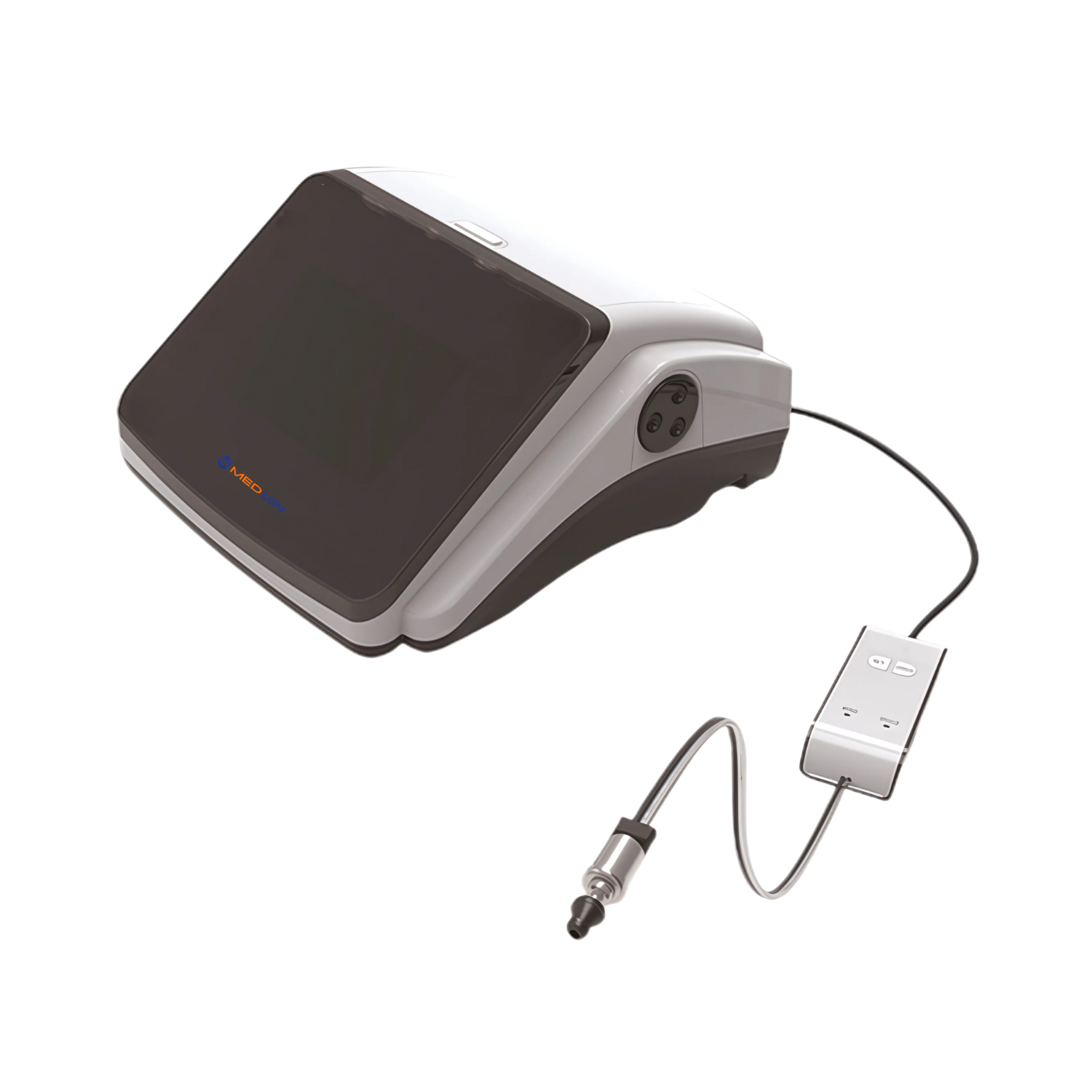
Tympanometer MTM-701 delivers a maximum sound intensity of 110dB HL (ipsilateral) and 120dB HL (contralateral) for accurate auditory assessments. Its stimulation range spans 50dB to 100dB for 500Hz to 2000Hz and 50dB to 80dB for 4000Hz, making it ideal for diverse hearing evaluations. With ipsilateral and contralateral stimulus options, the device provides comprehensive and precise diagnostic capabilities.
| Probe Tone Options | 226Hz (85dB SPL) 678Hz 800Hz 1000Hz |
|---|---|
| Stimulation Level | 500Hz to 2000Hz (50dB to 100dB) 4000Hz (50dB to 80dB) |
| Maximum Sound Intensity Ipsilateral | 110dB HL |
| Maximum Sound Intensity Contralateral | 120dB HL |
| Tympanogram Measuring Range | 0.2cm³ to 5cm³ |
| Tympanum Compensation Diagram Range | 0cm³ to 2cm³ |
| Pressure Range | -600 to +400 daPa |
| Tympanogram Test mode | Acoustic admittance (Y) Acoustic susceptance (B) Acoustic conductance (G) |
| Acoustic Reflex Test mode | Fixed strength Automatic threshold Increasing strength Manual |
| Additional Tests | Acoustic attenuation test Acoustic reflex latency test (ARLT) |
| Pump Control | Auto and Manual |
| Pump Pressure Velocity | 15 50 100 200 300 400 600 daPa/s |
| Automatic Range | 200 to 600 daPa/sec |
| Eustachian Tube Test | Testing of intact tympanic membrane and Eustachian tube Testing of perforated tympanic membranes and Eustachian tubes |
| Stimulus Types | Ipsilateral Contralateral |
| Noise Types | BBN (Broadband noise) LPN (Low-pass noise) HPN (High-pass noise) |
| Quick Auto Test | Test A B (Tympanogram and Acoustic reflection sequence) |
| Total Harmonic Distortion | Less than 1% (226Hz, 85dB SPL) |
| Stimulation Level Accuracy | No more than ±5% |
| Maximum Permissible Error | No more than ±1% |
Advanced probe tone options
Comprehensive tympanometry analysis
Advanced pressure and pump control
Acoustic reflex testing
Versatile stimulus options
Superior harmonic performance
Tympanometer MTM-701 is a vital instrument for audiologists, otolaryngologists, and hearing specialists, enabling precise evaluation of middle ear function, hearing impairments, acoustic reflexes, and Eustachian tube function. Its advanced tympanometry and reflex testing features make it highly effective in detecting ear infections, conductive hearing loss, and tympanic membrane abnormalities.